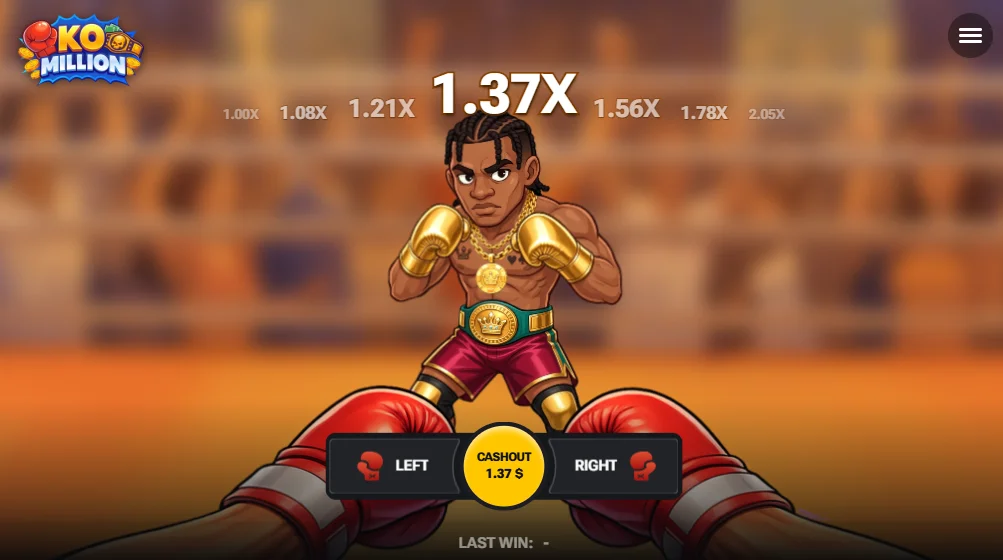
The bell sounds, your gloves rise into frame, and KO Million shows a multiplier of x1.00 before a single blow has been thrown. Seen through the boxer's own eyes, KO Million is an InOut Games instant title in which a challenger stands opposite you and may floor you on any step of the fight.
What happens next is brief and tense. Every punch you land lifts the multiplier one notch along a fixed path.
Every punch is also a chance for the round to end in a knockout, and a knockout takes the whole stake with it. Between those two outcomes lies the single choice that decides each bout: when to stop and collect.
There are no reels here, no paylines, no free spins waiting to trigger. The tempo belongs to you, whether you throw one punch at a time or let them fly in a steady stream.
What follows tracks one fight from opening bell to final count. Later sections cover the four settings, the official figures, fairness checks, access to KO Million and the routines that keep a session sensible.
Setting Your Stake
The stake goes in before the bell. As standard, KO Million sets its per-fight stake floor at €0.12, with €200 as the ceiling. Operators are allowed to adjust that window, so a given lobby might show a slightly different floor or ceiling.
Whatever amount you choose becomes the base for every multiplier. Collect at any point and you receive that base times the figure currently on the board.
Size the stake against the whole session budget, not a single fight. Rounds last seconds, and a modest-looking amount can drain a balance quickly over dozens of fights.
A level worth considering is one that survives a string of quick knockouts without a fresh deposit.
Raising the stake changes nothing about the fight itself. The modes and their paths stay identical at the bottom of the window or the top. Only the sum riding on them grows.
Picking an opponent in KO Million
Next you pick who to face. The game has four difficulty settings, and each one sends out its own boxer together with a separate multiplier path.
Each challenger's belt bears its own emblem, chosen from snake, skull, crown and lion. The symbols give every fighter a recognisable identity before the first exchange.
Your choice of setting fixes two things together: the number of steps and the ceiling. Easy runs over 30 steps and peaks at x23.24. Medium has 25 steps and climbs to x2,457.
Hard trims the path to 22 steps with a ceiling of x62,162.09. Hardcore crams everything into 18 steps, its summit being x3,608,855.25.
Fewer steps and steeper numbers come at a cost. Tougher settings bring greater volatility, so results drift much further apart from one fight to the next.
Choosing an opponent is less a test of nerve than a matter of fitting the fight to your available bankroll. Easy suits players who like a gentle climb in small increments. Hardcore opens at x1.44 and covers an enormous span in very few steps, which makes every single step there carry real weight.
The first punches
Each fight in KO Million kicks off at x1.00, regardless of the setting. The first punch moves you onto the path, and from then on each new punch climbs a step and lifts the figure again.
The setting decides the path. On Easy, values travel between x1.01 and x23.24 over 30 steps, so the climb is gradual and the increments small. Hardcore covers a vastly wider span in just 18 steps, so the gap between one step and the next means far more there.
Nobody knows how long the fight will last. The path tells you what each further step is worth; it never tells you whether you will reach it.
Taking the round one punch at a time leaves a beat to think between steps. That pause is useful. It is the moment to compare the current figure with whatever you decided to settle for before the bell.
Each punch is a fresh random event. A run of five clean punches leaves the sixth no safer, and a quick defeat last round says nothing about this one. No sequence of results, however striking it looks, reveals where the coming knockout is hiding.
When to take the money
Collecting is never locked. Take it and the fight ends, paying the stake times whatever multiplier is displayed right then. The bout finishes on your terms and the payout is settled.
Here is an illustration, nothing more. Picture a €5 stake on Easy that survives all the way to the last Easy step at x23.24. Collecting there would return €116.20.
Treat that sum as a worked example of the arithmetic. It is not a forecast, and there is no telling where any particular fight will stop.
What makes the decision hard is that the stakes shift as the round goes on. At x1.00 you only risk what you put in. After the multiplier has risen, staying in exposes that built-up value as well, since a knockout erases both the stake and everything the board had reached.
So every extra punch is a trade. You swap a sure amount for a chance at a larger one, with no information about how close the knockout might be.
The call is hardest in the heat of the moment, after a few good steps have raised expectations. A figure that felt generous before the bell can look small halfway through, and that shift in perception is what tends to cost money.
Holding the button to keep going
Hold down the spacebar on a computer, or the Play button on mobile, and punches follow one another until you stop or the challenger lands a knockout.
Continuous play changes the feel of a round. The small pause after each step disappears, and the multiplier moves faster than many people expect.
It suits players who already know roughly where they want to get out. It is far less suited to anyone still deciding mid-round, because the decision then has to be made at speed.
A good habit is to try continuous play in the demo first, just to get a sense of the rhythm. Rushed choices are one of the classic ways a session drifts away from its plan, and a stream of rapid punches makes rushing very easy.
The knockout in KO Million
The knockout is the hinge on which every KO Million round turns. No step is safe from it, the very first one included, and the fight ends on the spot.
You lose the entire stake. Any multiplier the board was showing vanishes too, however high it had got. Nothing is refunded, there is no consolation payment, and no bonus round exists to cushion the loss.
Because every punch is random, a knockout carries no message. It does not mean the next fight is due to run longer, and a long fight does not mean a knockout is overdue. Each round is independent of the ones before it.
This is where chasing losses becomes tempting. A couple of quick defeats can create a strong pull towards a bigger stake or a tougher setting in the hope of recovering everything.
That move rarely ends well, since the odds of the next fight have not changed in the slightest; only the amount exposed to them has. Accepting the knockout as part of the format is what keeps KO Million playable.
KO Million mode table
All four settings follow one structure yet differ sharply in length and spread. Here are the published numbers side by side.
| Mode | Steps | Range |
|---|---|---|
| Easy | 30 | lowest x1.01, highest x23.24 |
| Medium | 25 | lowest x1.08, highest x2,457 |
| Hard | 22 | lowest x1.18, highest x62,162.09 |
| Hardcore | 18 | lowest x1.44, highest of all x3,608,855.25 |
Scanning down the rows, a pattern stands out. The step count falls with each level, while the starting value and the ceiling rise.
Easy gives you the longest route and the tightest spread. Thirty steps lie between x1.01 and x23.24, so progress feels steady and each punch adds only a small increment.
Medium marks a real change of scale. Its 25 steps lead from x1.08 to a top value in the thousands.
Hard and Hardcore go much further. The highest values on those two paths are so big that, at nearly every stake, they overshoot the largest amount KO Million will hand over. The cap is covered further down, and it matters most for exactly these two modes.
Put simply, the lower rows swap length for steepness. Fewer punches separate the start from the top, but each of those punches is a bigger leap and the swings in results are wider.
Picking a mode is a choice about the kind of session you want, not a route to a better result. None of the four alters the long-term return or makes the knockout predictable.
The studio and the mechanic
InOut Games developed KO Million and launched it in 2026. The title sits in the crash family and runs on Step Multiplier, a mechanic of the studio's own design.
Crash games share a simple idea: a multiplier climbs, the round can end without warning, and the player chooses when to leave.
Step Multiplier gives that idea a particular shape. The climb is broken into distinct steps rather than a continuous curve, and each step is triggered by a punch. The player therefore controls the pace of the round as well as its end point.
The boxing theme wraps around that mechanic. Viewed in first person, every bout sets you against one of four challengers, and each step along the path turns into a punch inside the ring.
Studio and casino play different roles. InOut Games creates the title, while the licensed operator hosting it manages accounts, payments in and out, identity checks, limits and house rules.
RTP and Volatility Explained
KO Million carries a published RTP of 95.4%. That percentage is the theoretical slice of all wagers returned as winnings over a vast number of fights.
It does not describe a session. Across a handful of fights, outcomes may land far over or far under that percentage, and any single round ends either in a cash-out or in a knockout, never somewhere between.
What the RTP does show is that the game keeps a margin over the long run, a good reason to treat every stake as the price of entertainment rather than an investment.
Volatility is a different question, and here it hinges on the setting selected: the tougher the mode, the more volatile the ride.
In plain terms, Easy keeps outcomes in a tighter band, while the two toughest settings swing more violently, and longer losing stretches can separate the bigger returns.
Neither RTP nor volatility can be influenced by the player. No staking pattern, mode switch or timing trick alters the maths underneath.
Stakes and maximum win
These points set out what a round can cost and what it can return.
- Default stake limits per round: €200 at most, €0.12 at least.
- Each casino may define its own range, so a particular lobby could offer tighter or looser limits than the default.
- A single fight pays €20,000 at most, no matter how high the multiplier went.
- On the harder modes, the highest multipliers can exceed what is paid. At the top of Hardcore, even the minimum stake would go far beyond the cap, and the payout stops at €20,000.
- You will not find a bonus round in KO Million, and no bonus buy either. Every return comes from the multiplier path and nothing else.
- Casino promotions are a separate matter, ruled by each operator's conditions. These can reduce how far instant-game play counts towards wagering, leave some titles out entirely, or impose a stake ceiling while the promotion runs.
Forgetting the cap is a common mistake. Chasing the giant numbers at the end of Hard or Hardcore makes little sense once you know the payout is limited per round regardless.
Verifying the Fight
KO Million is provably fair: once a fight is over, its result is open to verification.
The settings menu displays a client seed alongside a server seed. Any earlier fight remains open to checking in the bet history.
That check works backwards, not forwards. It confirms that a completed bout was left untouched afterwards. It offers no window onto where the coming knockout will fall.
This is worth remembering whenever predictors appear. Apps, bots, signal groups and so-called hacks that claim to know where the knockout falls are selling something that cannot exist, since every punch is random.
Some of these schemes go further, asking for log-in details or a payment, or pushing an APK file to install. KO Million needs no download at all, and nothing outside the game can see its next result.
Lookalike websites and casinos operating without a licence that borrow the game's name call for equal caution.
Practising for free
On many casino sites, newcomers can launch KO Million in demo form without paying anything. Whether it is offered varies by operator, so one lobby may include it while another does not.
The demo plays with virtual credit rather than real money. That makes it the ideal spot to learn each setting, to see how fast continuous play runs and to notice how readily a planned cash-out point gets forgotten.
The one thing the demo cannot reproduce is the weight of real money. Decisions that seem simple with virtual credit often feel heavier once your own balance is involved, so the move to real stakes is best made gradually.
Browsers, phones and tablets
Built in HTML5, the game loads straight inside desktop and mobile browsers. Nothing has to be downloaded or installed.
Any file or store listing presenting itself as a KO Million app should be treated with caution.
On a phone, holding Play replaces the keyboard's spacebar. A compact display leaves less space for reading numbers, so give yourself an extra second before each call.
A stable connection matters too. Weak signal and rapid punches are a poor mix.
Licensed casinos and age rules
Real stakes are available solely through licensed online operators whose catalogue includes InOut Games titles, and solely to adults of 18 and above.
Before registering, confirm that the operator is properly licensed, that it serves your place of residence and that its betting limits fit your budget.
From there, the steps are routine: create an account, get your identity verified, deposit, and look for KO Million in the instant games area.
Keeping KO Million fun
Fights in KO Million are often over within seconds, and that pace is exactly why a session needs a frame around it.
Decide on a spending limit before the first fight and regard that sum as already paid for an evening's entertainment. Add a clock limit too, since rapid rounds blur any sense of how much time has passed.
Settle on a loss limit and, if you like, a target at which you stop for the day. Neither guarantees anything, but both put a natural end to the session.
Breaks help more than they seem to. Stepping away briefly often reveals that the plan has started to drift.
Most casinos offer deposit and time limits, and many also provide self-exclusion. Use them early, not as a last resort.
If gambling stops feeling like entertainment, or starts affecting your money, rest or close relationships, a professional help organisation is the right place to call. Talking to someone trained for exactly this is a sign of good judgement.
Notes before the first real fight
A few points are worth having in mind before you stake real money.
| Point | What it means for you |
|---|---|
| Knockout | You forfeit the stake plus whatever multiplier was showing |
| Mode | Tougher settings carry greater volatility and bigger swings |
| Cap | Whatever the multiplier, €20,000 per round is the limit |
| Bonus features | None at all, bonus buy included |
| RTP | 95.4% describes the very long term, not your evening |
| Randomness | No method or tool can guarantee a win or foresee a knockout |
| Demo | Many casinos offer it, and it costs nothing to try |
| Age | Real-money access is limited to over-18s |