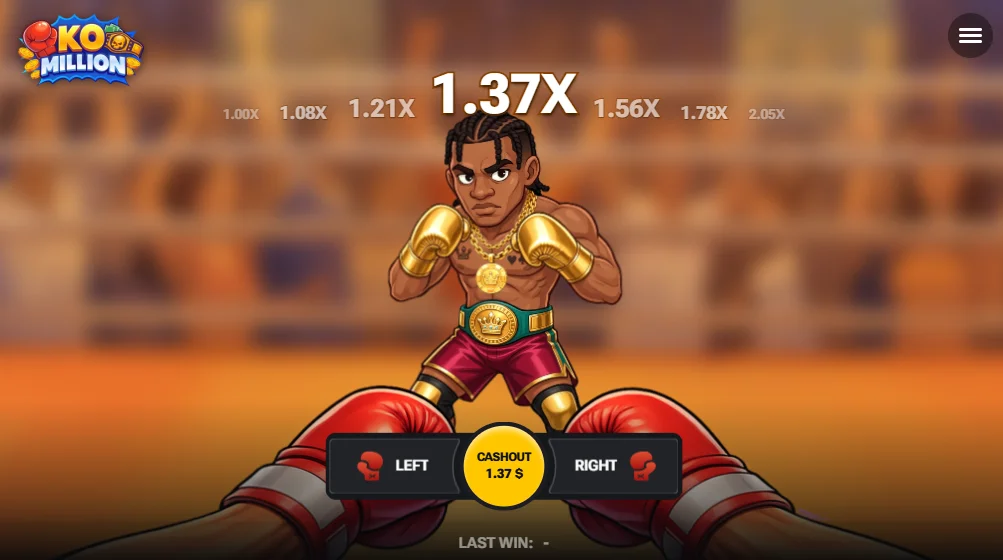
The bell sounds, your gloves rise into frame, and KO Million shows a multiplier of x1.00 before a single blow has been thrown. Seen through the boxer's own eyes, KO Million is an InOut Games instant title in which a challenger stands opposite you and may floor you on any step of the fight.
What happens next is brief and tense. Every punch you land lifts the multiplier one notch along a fixed path.
Every punch is also a chance for the round to end in a knockout, and a knockout takes the whole stake with it. Between those two outcomes lies the single choice that decides each bout: when to stop and collect.
There are no reels here, no paylines, no free spins waiting to trigger. The tempo belongs to you, whether you throw one punch at a time or let them fly in a steady stream.
What follows tracks one fight from opening bell to final count. Later sections cover the four settings, the official figures, fairness checks, access to KO Million and the routines that keep a session sensible.
Setting Your Stake
The stake goes in before the bell. As standard, KO Million sets its per-fight stake floor at ₱7.4, with ₱12,400 as the ceiling. Operators are allowed to adjust that window, so a given lobby might show a slightly different floor or ceiling.
Whatever amount you choose becomes the base for every multiplier. Collect at any point and you receive that base times the figure currently on the board.
Size the stake against the whole session budget, not a single fight. Rounds last seconds, and a modest-looking amount can drain a balance quickly over dozens of fights.
A level worth considering is one that survives a string of quick knockouts without a fresh deposit.
Raising the stake changes nothing about the fight itself. The modes and their paths stay identical at the bottom of the window or the top. Only the sum riding on them grows.
Picking an opponent in KO Million
Next you pick who to face. The game has four difficulty settings, and each one sends out its own boxer together with a separate multiplier path.
Each challenger's belt bears its own emblem, chosen from snake, skull, crown and lion. The symbols give every fighter a recognisable identity before the first exchange.
Your choice of setting fixes two things together: the number of steps and the ceiling. Easy runs over 30 steps and peaks at x23.24. Medium has 25 steps and climbs to x2,457.
Hard trims the path to 22 steps with a ceiling of x62,162.09. Hardcore crams everything into 18 steps, its summit being x3,608,855.25.
Fewer steps and steeper numbers come at a cost. Tougher settings bring greater volatility, so results drift much further apart from one fight to the next.
Choosing an opponent is less a test of nerve than a matter of fitting the fight to your available bankroll. Easy suits players who like a gentle climb in small increments. Hardcore opens at x1.44 and covers an enormous span in very few steps, which makes every single step there carry real weight.
The first punches
Each fight in KO Million kicks off at x1.00, regardless of the setting. The first punch moves you onto the path, and from then on each new punch climbs a step and lifts the figure again.
The setting decides the path. On Easy, values travel between x1.01 and x23.24 over 30 steps, so the climb is gradual and the increments small. Hardcore covers a vastly wider span in just 18 steps, so the gap between one step and the next means far more there.
Nobody knows how long the fight will last. The path tells you what each further step is worth; it never tells you whether you will reach it.
Taking the round one punch at a time leaves a beat to think between steps. That pause is useful. It is the moment to compare the current figure with whatever you decided to settle for before the bell.
Each punch is a fresh random event. A run of five clean punches leaves the sixth no safer, and a quick defeat last round says nothing about this one. No sequence of results, however striking it looks, reveals where the coming knockout is hiding.
When to take the money
Collecting is never locked. Take it and the fight ends, paying the stake times whatever multiplier is displayed right then. The bout finishes on your terms and the payout is settled.
Here is an illustration, nothing more. Picture a ₱310 stake on Easy that survives all the way to the last Easy step at x23.24. Collecting there would return ₱7,200.
Treat that sum as a worked example of the arithmetic. It is not a forecast, and there is no telling where any particular fight will stop.
What makes the decision hard is that the stakes shift as the round goes on. At x1.00 you only risk what you put in. After the multiplier has risen, staying in exposes that built-up value as well, since a knockout erases both the stake and everything the board had reached.
So every extra punch is a trade. You swap a sure amount for a chance at a larger one, with no information about how close the knockout might be.
The call is hardest in the heat of the moment, after a few good steps have raised expectations. A figure that felt generous before the bell can look small halfway through, and that shift in perception is what tends to cost money.
Holding the button to keep going
Hold down the spacebar on a computer, or the Play button on mobile, and punches follow one another until you stop or the challenger lands a knockout.
Continuous play changes the feel of a round. The small pause after each step disappears, and the multiplier moves faster than many people expect.
Il convient aux joueurs qui savent déjà à peu près où ils veulent s'arrêter. Il est beaucoup moins adapté à ceux qui décident encore en cours de route, car la décision doit alors être prise rapidement.
Une bonne habitude est d'essayer de jouer en continu dans la démo d'abord, juste pour avoir un sens du rythme. Des choix précipités sont l'un des moyens classiques par lesquels une session s'éloigne de son plan, et une série de coups rapides facilite beaucoup cette précipitation.
Le knockout dans KO Million
Le knockout est le pivot autour duquel chaque round de KO Million tourne. Aucun pas n'est à l'abri, y compris le tout premier, et le combat se termine sur le champ.
Vous perdez la totalité de la mise. Tout multiplicateur affiché par le tableau disparaît également, peu importe à quel point il avait grimpé. Rien n'est remboursé, il n'y a pas de paiement de consolation, et aucun tour bonus n'existe pour amortir la perte.
Parce que chaque coup est aléatoire, un knockout ne porte aucun message. Cela ne signifie pas que le prochain combat va durer plus longtemps, et un long combat ne signifie pas qu'un knockout est dû. Chaque round est indépendant des précédents.
C'est ici que la tentation de courir après les pertes devient forte. Quelques défaites rapides peuvent créer une forte envie d'augmenter la mise ou de choisir un paramètre plus difficile dans l'espoir de tout récupérer.
Ce mouvement se termine rarement bien, car les chances du prochain combat n'ont pas changé d'un poil; seule la somme exposée à celles-ci a changé. Accepter le knockout comme partie intégrante du format est ce qui rend KO Million jouable.
Tableau des modes KO Million
Tous les quatre réglages suivent une structure mais diffèrent considérablement en longueur et en répartition. Voici les chiffres publiés côte à côte.
| Mode | Étapes | Plage |
|---|---|---|
| Facile | 30 | le plus bas x1.01, le plus haut x23.24 |
| Moyen | 25 | le plus bas x1.08, le plus haut x2,457 |
| Difficile | 22 | le plus bas x1.18, le plus haut x62,162.09 |
| Hardcore | 18 | le plus bas x1.44, le plus haut de tous x3,608,855.25 |
En consultant les lignes, un motif se distingue. Le nombre d'étapes diminue à chaque niveau, tandis que la valeur de départ et le plafond montent.
Facile vous donne le chemin le plus long et la répartition la plus étroite. Trente étapes se trouvent entre x1.01 et x23.24, donc le progrès semble constant et chaque coup ajoute seulement un petit incrément.
Moyen marque un véritable changement d'échelle. Ses 25 étapes vont de x1.08 à une valeur maximale dans les milliers.
Difficile et Hardcore vont beaucoup plus loin. Les plus grandes valeurs sur ces deux chemins sont si élevées qu'à presque chaque mise, elles dépassent le plus gros montant que KO Million paiera. Le plafond est couvert plus bas, et cela compte surtout pour ces deux modes précis.
En termes simples, les lignes inférieures échangent la longueur contre la pente. Moins de coups séparent le départ du sommet, mais chacun de ces coups représente un saut plus grand et les variations des résultats sont plus larges.
Choisir un mode est un choix sur le type de session que vous voulez, pas un chemin vers un meilleur résultat. Aucun des quatre n'altère le retour à long terme ni ne rend le knockout prévisible.
Le studio et le mécanisme
InOut Games a développé KO Million et l'a lancé en 2026. Le titre appartient à la famille des jeux de crash et fonctionne sur Step Multiplier, un mécanisme conçu par le studio lui-même.
Les jeux de crash partagent une idée simple : un multiplicateur grimpe, le round peut se terminer sans avertissement, et le joueur choisit quand partir.
Le Step Multiplier donne à cette idée une forme particulière. La montée est divisée en étapes distinctes plutôt qu'en une courbe continue, et chaque étape est déclenchée par un coup. Le joueur contrôle donc le rythme du round ainsi que son point final.
Le thème de la boxe s'enroule autour de ce mécanisme. Vu à la première personne, chaque combat vous oppose à l'un des quatre challengers, et chaque étape du chemin se transforme en un coup à l'intérieur du ring.
Le studio et le casino jouent différents rôles. InOut Games crée le titre, tandis que l'opérateur licencié qui l'héberge gère les comptes, les paiements entrants et sortants, les vérifications d'identité, les limites et les règles de la maison.
RTP et volatilité expliqués
KO Million affiche un RTP publié de 95.4%. Ce pourcentage représente la part théorique de tous les paris restitués sous forme de gains sur un grand nombre de combats.
Il ne décrit pas une session. Au cours d'une poignée de combats, les résultats peuvent se situer bien au-dessus ou bien en dessous de ce pourcentage, et chaque round se termine soit par un cash-out soit par un knockout, jamais quelque part entre les deux.
Ce que le RTP montre, c'est que le jeu maintient une marge sur le long terme, une bonne raison de considérer chaque mise comme le prix du divertissement plutôt que comme un investissement.
La volatilité est une question différente, et ici elle dépend du réglage sélectionné : plus le mode est difficile, plus le parcours est volatile.
En termes simples, Facile maintient les résultats dans une fourchette plus étroite, tandis que les deux réglages les plus difficiles fluctuent plus violemment, et de plus longues périodes de pertes peuvent séparer les gains plus importants.
Ni le RTP ni la volatilité ne peuvent être influencés par le joueur. Aucun schéma de mise, changement de mode ou astuce de timing ne modifie les calculs sous-jacents.
Mises et gain maximum
Ces points définissent ce qu'un round peut coûter et ce qu'il peut rapporter.
- Default stake limits per round: ₱12,400 at most, ₱7.4 at least.
- Each casino may define its own range, so a particular lobby could offer tighter or looser limits than the default.
- A single fight pays ₱1,240,000 at most, no matter how high the multiplier went.
- On the harder modes, the highest multipliers can exceed what is paid. At the top of Hardcore, even the minimum stake would go far beyond the cap, and the payout stops at ₱1,240,000.
- You will not find a bonus round in KO Million, and no bonus buy either. Every return comes from the multiplier path and nothing else.
- Casino promotions are a separate matter, ruled by each operator's conditions. These can reduce how far instant-game play counts towards wagering, leave some titles out entirely, or impose a stake ceiling while the promotion runs.
Forgetting the cap is a common mistake. Chasing the giant numbers at the end of Hard or Hardcore makes little sense once you know the payout is limited per round regardless.
Verifying the Fight
KO Million is provably fair: once a fight is over, its result is open to verification.
The settings menu displays a client seed alongside a server seed. Any earlier fight remains open to checking in the bet history.
That check works backwards, not forwards. It confirms that a completed bout was left untouched afterwards. It offers no window onto where the coming knockout will fall.
This is worth remembering whenever predictors appear. Apps, bots, signal groups and so-called hacks that claim to know where the knockout falls are selling something that cannot exist, since every punch is random.
Some of these schemes go further, asking for log-in details or a payment, or pushing an APK file to install. KO Million needs no download at all, and nothing outside the game can see its next result.
Lookalike websites and casinos operating without a licence that borrow the game's name call for equal caution.
Practising for free
On many casino sites, newcomers can launch KO Million in demo form without paying anything. Whether it is offered varies by operator, so one lobby may include it while another does not.
The demo plays with virtual credit rather than real money. That makes it the ideal spot to learn each setting, to see how fast continuous play runs and to notice how readily a planned cash-out point gets forgotten.
The one thing the demo cannot reproduce is the weight of real money. Decisions that seem simple with virtual credit often feel heavier once your own balance is involved, so the move to real stakes is best made gradually.
Browsers, phones and tablets
Built in HTML5, the game loads straight inside desktop and mobile browsers. Nothing has to be downloaded or installed.
Any file or store listing presenting itself as a KO Million app should be treated with caution.
On a phone, holding Play replaces the keyboard's spacebar. A compact display leaves less space for reading numbers, so give yourself an extra second before each call.
A stable connection matters too. Weak signal and rapid punches are a poor mix.
Licensed casinos and age rules
Real stakes are available solely through licensed online operators whose catalogue includes InOut Games titles, and solely to adults of 18 and above.
Before registering, confirm that the operator is properly licensed, that it serves your place of residence and that its betting limits fit your budget.
From there, the steps are routine: create an account, get your identity verified, deposit, and look for KO Million in the instant games area.
Keeping KO Million fun
Fights in KO Million are often over within seconds, and that pace is exactly why a session needs a frame around it.
Decide on a spending limit before the first fight and regard that sum as already paid for an evening's entertainment. Add a clock limit too, since rapid rounds blur any sense of how much time has passed.
Settle on a loss limit and, if you like, a target at which you stop for the day. Neither guarantees anything, but both put a natural end to the session.
Breaks help more than they seem to. Stepping away briefly often reveals that the plan has started to drift.
Most casinos offer deposit and time limits, and many also provide self-exclusion. Use them early, not as a last resort.
If gambling stops feeling like entertainment, or starts affecting your money, rest or close relationships, a professional help organisation is the right place to call. Talking to someone trained for exactly this is a sign of good judgement.
Notes before the first real fight
A few points are worth having in mind before you stake real money.
| Point | What it means for you |
|---|---|
| Knockout | You forfeit the stake plus whatever multiplier was showing |
| Mode | Tougher settings carry greater volatility and bigger swings |
| Cap | Whatever the multiplier, ₱1,240,000 per round is the limit |
| Bonus features | None at all, bonus buy included |
| RTP | 95.4% describes the very long term, not your evening |
| Randomness | No method or tool can guarantee a win or foresee a knockout |
| Demo | Many casinos offer it, and it costs nothing to try |
| Age | Real-money access is limited to over-18s |